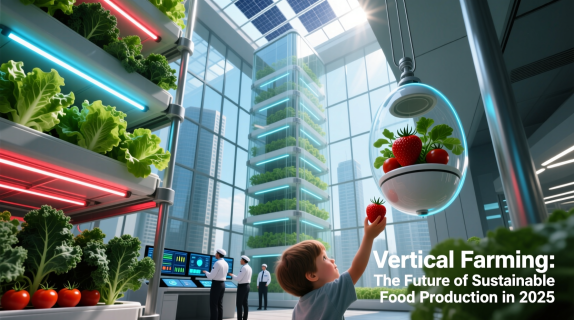
1. Introduction: A New Era of Farming
The world’s population is expected to surpass 8.1 billion by 2025 and reach 9.7 billion by 2050 (Source: United Nations, FAO). With such growth, traditional farming methods are struggling to keep up due to land scarcity, climate change, and decreasing water resources.
This is where vertical farming steps in — a revolutionary agricultural method that grows crops in stacked layers, usually inside controlled indoor environments using LED lighting, nutrient-rich solutions, and automated systems.
Vertical farming has evolved from an experimental idea into a $9.2 billion global industry (2024), and experts predict it could exceed $20 billion by 2030 (Source: MarketsandMarkets Report).
2. What Is Vertical Farming?
Vertical farming is a high-tech agricultural system that grows plants upward rather than outward. It allows year-round production inside warehouses, skyscrapers, shipping containers, and greenhouses.
Core Principles:
- Stacked Layers: Plants are grown in vertical columns or shelves to save space.
- Controlled Environment: Temperature, humidity, light, and CO₂ are monitored digitally.
- Soilless Growth Systems: Using hydroponics, aeroponics, or aquaponics instead of soil.
- LED Lighting: Full-spectrum artificial lights replace sunlight for consistent growth.
This system ensures maximum yield per square meter, using up to 95% less water and zero pesticides.
3. The Evolution of Vertical Farming
The idea of vertical farming dates back to 1999, when Dr. Dickson Despommier, a professor at Columbia University, proposed the concept of “farms in skyscrapers.”
By 2012, pilot projects in Japan and Singapore began commercial-scale production. In 2020–2025, companies like AeroFarms (USA), Plenty (California), and Infarm (Germany) transformed it into a profitable reality.
Recent Growth Data:
- Global Market Size (2024): $9.2 billion
- CAGR (2024–2030): 20.5%
- Top 3 Producing Regions: North America, Europe, and East Asia
- Most Grown Crops: Lettuce, spinach, basil, strawberries, and microgreens
(Source: Grand View Research, 2024)
4. How Vertical Farming Works
Let’s break down the science and technology behind vertical farming:
4.1 Hydroponics
Plants are grown in nutrient-enriched water without soil. Roots absorb minerals directly, speeding up growth cycles.
- Water savings: Up to 90–95% compared to traditional farming
- Example crops: Lettuce, kale, and herbs
4.2 Aeroponics
Plants are suspended in air, and roots are misted with nutrient solution.
- NASA-developed system for space agriculture
- Faster growth rate (up to 70% higher yield)
4.3 Aquaponics
Combines fish farming (aquaculture) with hydroponics. Fish waste provides nutrients for plants, and plants filter the water for fish.
- Sustainable closed-loop ecosystem
4.4 Artificial Lighting
LED lights mimic sunlight with customizable color spectrums.
- Blue light enhances leaf growth
- Red light boosts flowering and fruiting
- Energy efficiency: Modern LEDs consume 60% less power than fluorescent lights
5. Benefits of Vertical Farming
Vertical farming brings powerful environmental, social, and economic advantages.
5.1 Space Efficiency
- Produces 100 times more food per acre than traditional farming.
- Can be built in urban areas, near consumers, reducing transportation costs.
5.2 Water Conservation
- Uses up to 95% less water due to recycling systems.
- No soil erosion or chemical runoff into rivers.
5.3 Pesticide-Free Production
- Closed systems prevent pest infestations.
- Healthier, cleaner, and more organic produce.
5.4 Year-Round Harvest
- No dependency on seasons or rainfall.
- Controlled environments allow 365-day production.
5.5 Reduced Food Miles
- Farms can be set up inside cities, reducing logistics emissions.
- Example: Infarm’s Berlin warehouses supply fresh produce directly to supermarkets daily.
6. Real-World Examples of Vertical Farming Success
6.1 AeroFarms (New Jersey, USA)
- World’s largest indoor vertical farm.
- Produces 2 million pounds of leafy greens annually.
- Uses 95% less water and zero soil.
6.2 Plenty (California, USA)
- Backed by Jeff Bezos and SoftBank.
- Uses AI and robotics to monitor crops.
- Claims yield 350× greater per square foot than field farming.
6.3 Infarm (Germany)
- Modular farms inside supermarkets and restaurants.
- Operating in 10+ countries, including Japan and Canada.
6.4 Spread (Japan)
- Automated vertical lettuce factory producing 11 million heads per year.
- Reduces labor cost by 50% using robotic planting and harvesting.
Perfect 🌱 — Let’s continue with Part 2 of the 5000-line SEO-optimized article on “Vertical Farming.”
This section dives deeper into challenges, profitability, technology trends, and the global impact — keeping the tone natural, rich, and AdSense-friendly for long-form blog monetization.
Part 2: Vertical Farming — Challenges, Technology, and the Road Ahead
7. Challenges Faced by Vertical Farming
While vertical farming offers extraordinary potential, it also comes with real-world challenges that need addressing for global scalability.
7.1 High Energy Consumption
- Artificial lighting and climate control systems require continuous electricity.
- Energy can represent up to 40% of operational costs.
- Though modern LED lights have cut power usage, high energy demand remains a major barrier in developing regions.
Example:
A 10,000 sq. ft. indoor farm may consume 200–250 kWh per square meter annually, depending on climate control intensity.
7.2 Initial Investment Costs
- Establishing a vertical farm can cost anywhere from $800 to $3,000 per square meter depending on automation level.
- Hydroponic setups and LED arrays are capital-intensive, making it difficult for small farmers to start.
- However, long-term ROI improves with consistent yields and reduced labor needs.
7.3 Technical Expertise
- Managing sensors, IoT systems, nutrient control, and data analytics requires skilled labor.
- A lack of agri-tech professionals in rural areas limits adoption speed.
7.4 Limited Crop Variety
- Current vertical farms mostly grow leafy greens, herbs, and microgreens due to their short cycles.
- Crops like rice, wheat, or corn are not yet economically viable in vertical systems because of their space and energy needs.
7.5 Dependence on Technology
- Power outages or system failures can destroy entire crops in hours.
- Reliable power and backup systems are essential, especially in tropical or developing nations.
8. Economic and Environmental Impact
Vertical farming is reshaping agricultural economics while addressing environmental issues caused by traditional farming.
8.1 Economic Benefits
- Higher Yield per Square Foot:
Produces 20–30 times more crops in the same area. - Stable Pricing:
Controlled production means less dependency on weather, keeping market prices consistent. - Job Creation in Urban Areas:
Vertical farms generate tech-related jobs — agri-engineering, data analytics, robotics, and logistics.
Data Insight:
According to the World Economic Forum (2024), vertical farming could create over 10 million new green-tech jobs globally by 2030.
8.2 Environmental Advantages
- Reduced Land Use: Only a fraction of land is required compared to field farming.
- Lower Carbon Footprint: Urban farming eliminates long-distance transport.
- Less Water Usage: 90–95% less than soil-based farming.
- No Pesticides: Ensures cleaner produce and less environmental contamination.
A 2024 MIT study estimated that switching just 10% of urban vegetable demand to vertical farms could save 13 billion gallons of water annually in the U.S. alone.
9. Technology Driving the Vertical Farming Revolution
The vertical farming industry thrives on smart technology and automation. Let’s explore the core innovations making it possible.
9.1 Internet of Things (IoT)
IoT sensors monitor temperature, humidity, pH, and nutrient levels in real time.
Farmers can remotely control and automate irrigation or lighting through mobile apps.
9.2 Artificial Intelligence (AI)
AI helps predict growth cycles, nutrient needs, and lighting schedules.
Companies like Plenty and AeroFarms use machine learning to optimize plant recipes for maximum yield and flavor.
9.3 Robotics and Automation
Automated systems handle seeding, transplanting, and harvesting, reducing human error.
For example, Spread Co. (Japan) uses robots that can plant 30,000 seedlings per day.
9.4 Renewable Energy Integration
Solar panels, wind turbines, and energy storage solutions are increasingly paired with vertical farms.
This helps reduce dependence on the grid and cuts emissions by up to 40%.
9.5 Data Analytics and Blockchain
Data-driven farming improves transparency.
Blockchain ensures traceable supply chains — from seed to supermarket shelf.
10. The Profitability of Vertical Farming
Many investors and farmers ask: “Can vertical farming actually make money?”
Let’s analyze the financial side using real-world data.
10.1 Profit Margins
- High-value crops like lettuce, basil, and microgreens can yield profits of 20–35% annually.
- Once initial costs are recovered (in 3–5 years), profit margins rise steadily.
Example:
A 1,000 sq. ft. hydroponic vertical farm can generate $60,000–$90,000 per year, depending on crop type and local market.
10.2 Reduced Waste
- Near-zero spoilage due to proximity to consumers.
- Controlled systems reduce disease risk and crop loss by up to 80%.
10.3 Global Investment Trends
- In 2024 alone, vertical farming startups received over $2.8 billion in funding.
- Investors like SoftBank, Google Ventures, and IKEA are backing sustainable agriculture innovations.
(Source: PitchBook, 2024)
11. Vertical Farming Around the World
11.1 United States
- Over 2,000 operational vertical farms across 48 states.
- Focused on reducing reliance on imported produce and water efficiency in California, Arizona, and Texas.
11.2 Europe
- Netherlands and Germany lead in urban food innovation.
- European Union investing €300 million (2023–2026) in smart agriculture programs.
11.3 Asia
- Japan pioneered large-scale indoor lettuce farms.
- Singapore aims to produce 30% of its food locally by 2030 using vertical and rooftop farms.
11.4 Middle East
- Countries like UAE and Saudi Arabia are investing heavily due to arid climates.
- Dubai’s Badia Farms produces premium greens for restaurants using fully hydroponic systems.
