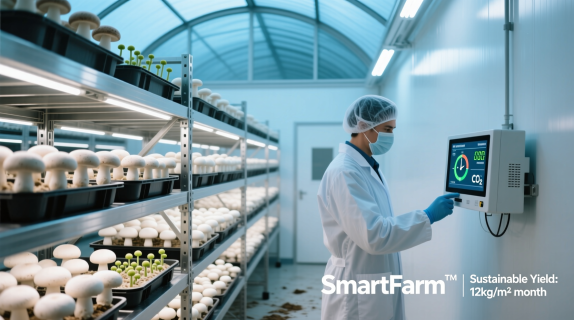
Driving the Evolution of Agriculture: Advanced Technologies that Empower Farmers
For millennia, farming was a testament to human resilience, guided by the sun, the soil, and generations of hard-won wisdom. While that core connection to the land remains, a quiet, data-driven revolution is sweeping across our fields. Today’s farmers are not just cultivators; they are technologists, data analysts, and sustainability stewards, leveraging an arsenal of advanced tools to meet the grand challenge of feeding a growing population.
This isn’t about replacing tradition; it’s about augmenting it with unparalleled intelligence. Welcome to the new era of agriculture, where every seed, every drop of water, and every square foot of soil is understood and optimized like never before. Let’s dive into the key technologies driving this evolution.
- The Foundation: Precision Agriculture & GPS Guidance
Imagine planting a field without a single crooked row or applying fertilizer with centimeter-level accuracy. This is the reality ushered in by Precision Agriculture, fundamentally built on the backbone of Global Positioning System (GPS) technology.
1.1. How It Actually Works
GPS receivers mounted on tractors and farm equipment communicate with satellites to pinpoint their exact location in a field in real-time. This data is fed into the vehicle’s computer, which can then automatically steer the equipment along pre-defined paths. This is far beyond the simple GPS on your phone; we’re talking about sub-inch accuracy using Real-Time Kinematic (RTK) correction systems.
1.2. The Tangible Impact on the Farm
The benefits aren’t just theoretical; they are measurable and profound:
· Dramatic Reduction in Overlaps and Skips: Before auto-guidance, even the best operators would overlap passes by up to 10%, wasting seed, fuel, and inputs. GPS steering has reduced this to near zero. A study by the American Society of Agricultural and Biological Engineers found that auto-steer systems can reduce skip and overlap areas by up to 90%, leading to input savings of 5-10%.
· 24/7 Operational Capability: Farmers can now work in low-visibility conditions, such as dust, fog, or night, minimizing downtime during critical planting or harvest windows. This resilience is becoming increasingly crucial with volatile weather patterns.
· The Foundation for Data Collection: Every pass a GPS-guided machine makes becomes a data-collection opportunity, creating the foundational map for all other precision ag practices.
A Real-World Analogy: Think of it like using a word processor with a spellchecker versus an old typewriter. The typewriter (traditional farming) gets the job done, but the word processor (precision farming) eliminates wasteful errors, increases speed, and creates a digital file (data) you can build upon later.
- The Rise of the Machines: Automation and Robotics
The sight of a driverless tractor working a field may seem like science fiction, but it’s quickly becoming science fact. Automation is addressing one of agriculture’s most pressing issues: labor shortages and the need for relentless efficiency.
2.1. From Assisted Steering to Fully Autonomous Systems
The journey to full autonomy is a spectrum:
· Auto-Guidance (We’re here): The farmer is in the cab for safety and oversight, but doesn’t touch the steering wheel.
· Supervised Autonomy (We’re entering this): A single operator can manage multiple machines simultaneously from a tablet. For example, one tractor with a driver can be accompanied by two or three autonomous tractors following the same path.
· Full Autonomy (The near future): Machines like John Deere’s 8R autonomous tractor or startups like Monarch and Sabanto are developing systems that can execute tasks from start to finish with remote supervision.

2.2. Specialized Agricultural Robots (AgBots)
Beyond tractors, a new breed of smaller, smarter robots is emerging for specific, labor-intensive tasks:
· Weeding Robots: Companies like FarmWise and Carbon Robotics use high-resolution cameras and AI to identify individual weeds. They then mechanically remove them or use a laser to zap them, eliminating the need for herbicides. The Carbon Robotics LaserWeeder claims to can destroy over 200,000 weeds per hour with millimeter accuracy.
· Harvesting Robots: Picking delicate fruits and vegetables has long been a human-only skill. Robots like Harvest CROO Robotics’ strawberry picker are using advanced vision systems and soft grippers to identify ripe berries and harvest them without bruising, working tirelessly through the night to ensure peak freshness.
The Human Benefit: This isn’t about replacing people, but about augmenting human capability. Automation takes the dull, dangerous, and repetitive tasks off the table, allowing farmers to focus on higher-level management, strategy, and caring for their land and livestock.
- The Eye in the Sky: Drones (UAVs) in Agriculture
Drones, or Unmanned Aerial Vehicles (UAVs), have become one of the most accessible and powerful tools in the modern farmer’s toolkit. They provide a bird’s-eye view that was once only possible with expensive airplane flyovers.
3.1. More Than Just Pretty Pictures: Multispectral Imaging
While standard RGB cameras are useful, the real magic happens with multispectral sensors. These sensors capture data from specific wavelengths of light, including those invisible to the human eye, like Near-Infrared (NIR).
Healthy plants reflect a lot of NIR light, while stressed plants (from lack of water, disease, or pests) reflect less. By calculating the difference between these light bands, drones generate Normalized Difference Vegetation Index (NDVI) maps.
3.2. Actionable Insights from Drone Data
An NDVI map is a colorful health report card for an entire field. But what does a farmer do with it?
· Early-Stage Problem Detection: A farmer can spot a developing fungal disease or pest infestation in a specific corner of the field weeks before it becomes visible to the naked eye during a walk-through.
· Precision Input Application: These health maps can be fed directly into variable-rate application systems. A sprayer can then automatically increase fertilizer or pesticide only in the areas that need it, as identified by the drone, reducing chemical use by 30-50% in some cases.
· Irrigation Management: Drones can identify areas of a field that are too dry or, surprisingly, too wet, allowing for precise irrigation adjustments that save water and prevent crop rot.
According to a 2023 report by DroneAnalyst, the agricultural drone market is growing at over 20% annually, with scouting and mapping being the primary use cases, demonstrating rapid adoption by forward-thinking farmers.
Of course! Here is Part 2 of the blog article, continuing directly from where we left off.
Meta Information for the Blog Post
(This remains the same for the overall article)
· Meta Title: Driving the Evolution of Agriculture: 7 Advanced Technologies Empowering Today’s Farmers
· Meta Description: Discover how precision farming, AI, drones, and IoT are revolutionizing agriculture. Learn about real data and technologies increasing yield, sustainability, and profitability for modern farmers.
· Meta Keywords: precision agriculture, smart farming, agricultural drones, farm IoT, AI in agriculture, sustainable farming, farm management software, agritech, future of farming
In Part 1, we saw how GPS, robotics, and drones are giving farmers superhuman levels of control and perception. They are the hands and eyes of the modern farm. But what makes this revolution truly intelligent is the brain—the systems that process all this information and turn it into actionable wisdom. That brings us to the core of the connected farm.
- The Digital Brain: Artificial Intelligence (AI) and Machine Learning
If data is the new oil, then Artificial Intelligence is the refinery that turns it into jet fuel. AI, particularly a subset called Machine Learning (ML), is what allows computers to learn from agricultural data without being explicitly programmed for every single scenario.
4.1. From Data to Predictive Insights
AI algorithms thrive on the massive datasets generated by drones, satellites, and soil sensors. They find patterns that are impossible for the human brain to discern at scale.
· Predictive Yield Modeling: By analyzing historical yield data, weather patterns, soil conditions, and real-time plant health, AI can predict a field’s yield with stunning accuracy long before harvest. This allows farmers to make better decisions about storage, logistics, and marketing. A study published in Nature demonstrated an AI model that could predict soybean yields with over 90% accuracy months in advance.
· Disease and Pest Identification: Apps like Plantix or FarmSense use image recognition. A farmer can simply take a photo of a diseased leaf or a suspicious insect, and the AI, trained on millions of images, identifies the problem in seconds and recommends a targeted treatment plan. This moves from blanket applications to precise, surgical strikes against threats.
4.2. AI-Driven Resource Optimization
One of the most powerful applications of AI is in resource management, particularly for water.
· Smart Irrigation: Companies like CropX and Jain Logic use AI to analyze data from soil moisture sensors, weather forecasts, and evapotranspiration rates. The system then prescribes exactly how much water to apply and when, to specific zones of a field. The World Economic Forum cites that smart irrigation can reduce water usage by up to 20-30%, a critical saving in drought-prone areas.
The Farmer’s New Assistant: Think of AI not as a replacement for the farmer’s intuition, but as a highly knowledgeable, data-driven assistant that works 24/7. It cross-references thousands of variables to provide recommendations, but the final decision—the art of farming—still rests in the experienced hands of the grower.
- The Nervous System: The Internet of Things (IoT) and Sensors
A farm is now studded with “smart” devices, all connected through the Internet of Things (IoT). These are the nerve endings, constantly feeling the pulse of the farm and sending signals back to the digital brain.
5.1. In-The-Ground and On-The-Go Sensing
IoT encompasses a vast network of wireless sensors that monitor conditions in real-time:
· Soil Sensors: Buried at different root-zone depths, these sensors continuously track moisture levels, temperature, salinity, and key nutrient levels like Nitrogen (N). This data is streamed directly to the farmer’s smartphone.
· Proximity Sensors in Livestock: For livestock farmers, IoT is a game-changer. Smart ear tags or collar sensors on cows can monitor an animal’s temperature, activity levels, and feeding patterns. The AI can then flag individuals that are becoming ill, often before any visible symptoms appear, or identify the optimal window for breeding.
5.2. The Challenge and Promise of Connectivity
The major hurdle for widespread IoT adoption in rural areas is connectivity. LoRaWAN (Long Range Wide Area Network) is becoming a popular solution, as it allows small packets of data to be transmitted over long distances (miles) with very low power consumption, perfect for a farm environment. As 5G networks expand, they will further unlock the potential for real-time, high-bandwidth data transfer from every corner of the operation.
According to a 2023 report by McKinsey & Company, the number of agricultural IoT connections is expected to grow by almost 20% annually, highlighting the rapid digitization of the farm landscape.
- The Central Command: Farm Management Software (FMS)
With all these technologies generating data, a central hub is needed to make sense of it all. Enter Farm Management Software (FMS)—the mission control for the modern farm.
6.1. The Unified Platform
Platforms like John Deere’s Operations Center, Climate FieldView, and FarmLogs act as digital dashboards. They integrate data from every source:
· GPS-guided machine paths
· Drone and satellite imagery
· Soil sensor readings
· Weather station data
· Input application records
6.2. The Power of “What-If” Analysis
An FMS is more than just a digital filing cabinet. Its true power lies in analytics. Farmers can use it to:
· Create Variable Rate Prescriptions: They can draw a map on their computer, telling the system to apply more seed in a high-yielding zone and less in a low-yielding one, then send that prescription directly to their planter.
· Track ROI Per Acre: By layering input cost data against yield data, a farmer can calculate the precise profitability of every single acre, identifying which practices are paying off and which are not.
· Ensure Traceability and Compliance: For farmers selling to specific markets (like organic or non-GMO), the FMS provides a verifiable, digital paper trail from planting to harvest, building consumer trust.
A Day in the Life: A farmer starts the morning by checking their FMS dashboard on a tablet. They see an alert from a soil moisture sensor in the back forty, a drone-generated NDVI map highlighting a potential stress area, and a automated report from the autonomous tractor that completed the night’s spraying. All this information is synthesized in one place, enabling informed decisions before even stepping out the door.
