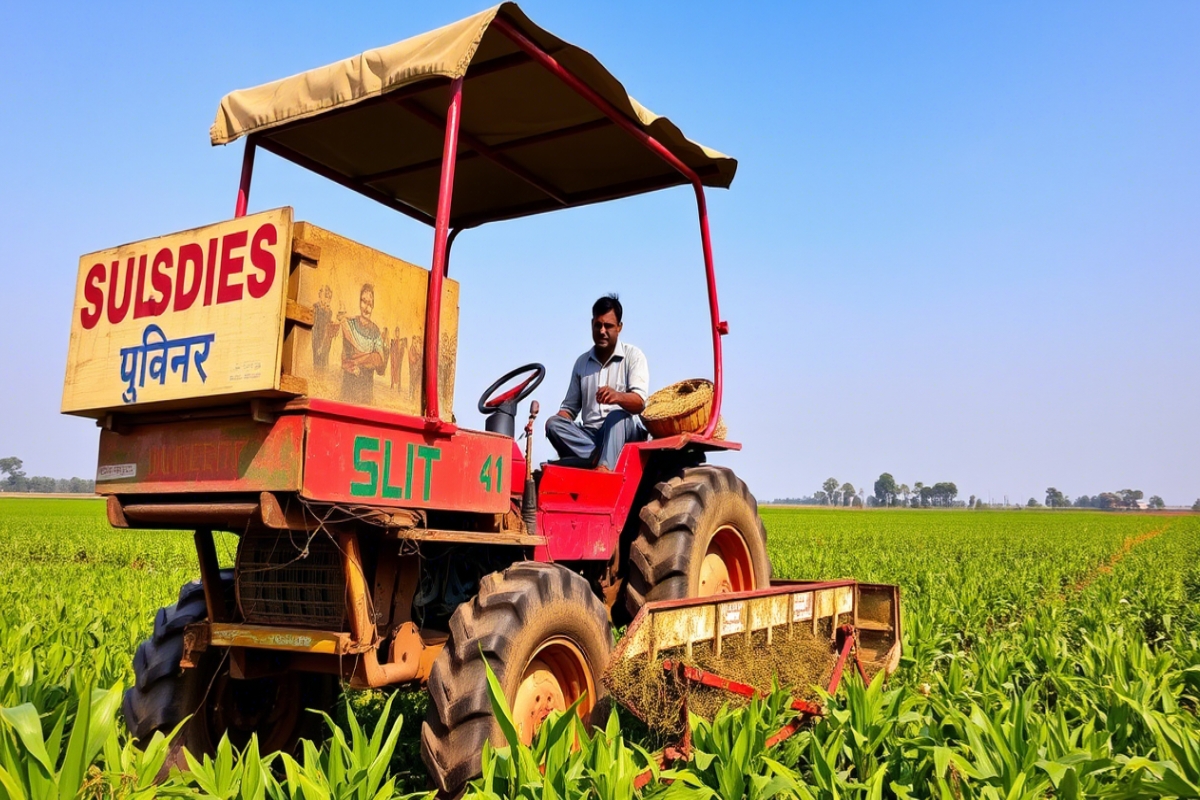
Discover how AI, drones, and smart farming are boosting yields & profits for Indian farmers. Explore real data, govt schemes, and the future of agriculture technology in 2025.
Close your eyes and picture a farmer in India. For decades, the image has been consistent: a weathered face under the harsh sun, hands working the soil, a bullock cart in the background. But open your eyes to 2025, and that picture is changing dramatically. Today, you’re just as likely to see a farmer piloting a drone, checking soil moisture on a smartphone, and analyzing satellite data of their field.
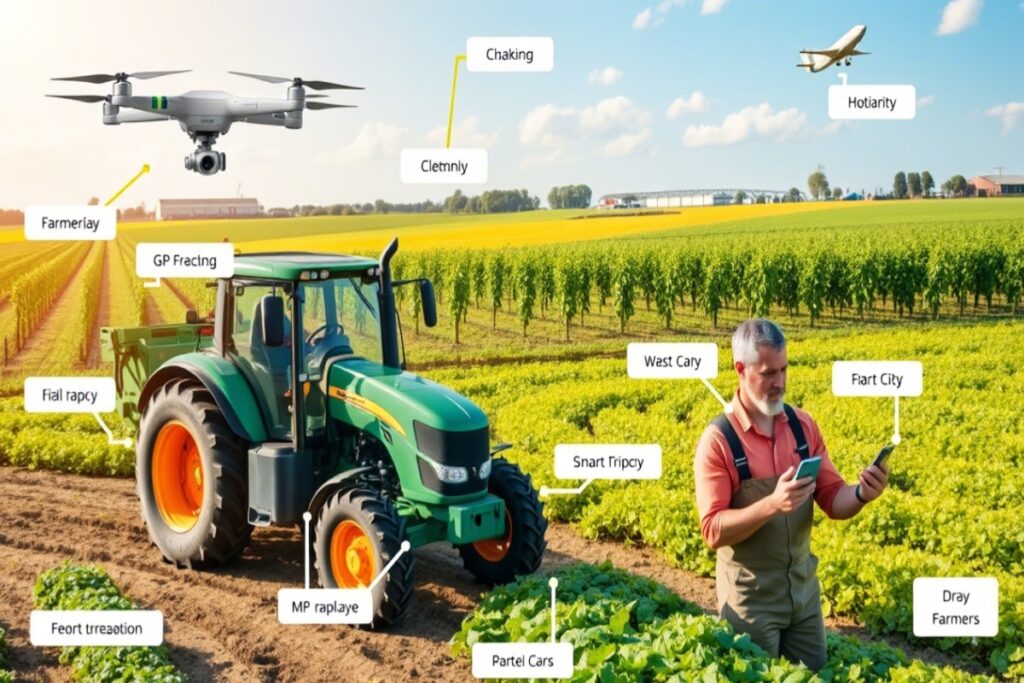
This isn’t a scene from a sci-fi movie; it’s the unfolding reality of Indian agriculture. We are in the midst of a digital green revolution, a silent transformation powered by technology that is making farming more precise, profitable, and sustainable. From the sprawling wheat fields of Punjab to the coffee plantations of Karnataka, technology is sowing the seeds for a new future.
This article is your guide to this incredible shift. We will explore the real-world technologies changing the game, backed by data and the stories of Indian farmers who are leading the charge.
- The Urgent Need for a Tech-Enabled Farm Revolution
Why is this shift so critical? The answer lies in the converging challenges facing Indian agriculture.
1.1. A Growing Population, A Shrinking Landmass
India’s population is set to surpass China’s,but our arable land is not expanding. In fact, due to urbanization and soil degradation, we are effectively farming less land per person. The only way to feed the nation is to grow more from less—to increase productivity dramatically.
1.2. The Unpredictable Climate Crisis
Erratic monsoons,unseasonal floods, and prolonged droughts are no longer exceptions; they are the new normal. Traditional farming calendars are becoming obsolete. Farmers need smart tools that can predict weather patterns, advise on the right time to sow, and help manage water efficiently.
1.3. The Rising Cost of Inputs and Labour
The cost of seeds,fertilizers, and pesticides is steadily increasing. Simultaneously, a shortage of farm labour is pushing wages higher. This squeezes the farmer’s profit margin, making it essential to optimize every single rupee spent on the field.
1.4. The Demand for Market-Linked Farming
The old model of growing first and selling later is fraught with risk.Today’s successful farmer needs to be market-smart, understanding what to grow, when to grow, and for whom. Technology is the bridge that connects the kisan directly to the market.
- The Digital Toolbox: Key Technologies Reshaping the Fields
Let’s dive into the specific technologies that are making waves across the Indian countryside.
2.1. Precision Farming: Doing More with Less
Imagine treating every square foot of your field based on its unique needs.That’s precision farming. It moves away from the blanket approach of applying water, fertilizers, and pesticides uniformly across the entire field.
· Soil Health Cards (The Foundational Tech): Launched by the Government of India, these are like Aadhar cards for soil. They provide farmers with a detailed analysis of their soil’s health, including nutrient status. This allows them to apply only the required type and quantity of fertilizers, reducing costs by 8-10% and improving soil health in the long run. Over 22 crore soil health cards have been distributed as of 2023, laying the groundwork for precision agriculture.
· Sensor Technology: Moisture sensors placed in the soil can send real-time data to a farmer’s phone, telling them exactly when and how much to irrigate. This can reduce water consumption by a staggering 20-30%, a critical saving in water-scarce regions.
2.2. The Internet of Things (IoT) and AI: The Smart Brains of the Farm
When sensors and devices talk to each other and are powered by Artificial Intelligence(AI), magic happens.
· AI-Powered Pest and Disease Prediction: Startups like CropIn and Ninjacart are using AI to analyze field images. A farmer can simply take a picture of a diseased leaf with their phone, and the AI model identifies the disease and recommends a precise remedy. This prevents panic-driven overuse of pesticides and saves the crop in time.
· Smart Irrigation Systems: Companies like Fasal are installing IoT-enabled stations in farms that continuously monitor micro-climatic conditions. Their AI platform then advises farmers on the optimal irrigation schedule, helping states like Maharashtra and Karnataka combat water stress effectively. Early adopters have reported yield increases of 15-20% and water savings of 25-30%.
2.3. Drones (Unmanned Aerial Vehicles): The Eyes in the Sky
Drones have moved from military hardware to essential farm equipment,and the government is aggressively promoting them through the ‘Kisan Drone’ scheme.
· Crop Monitoring: A drone with a multispectral camera can fly over a 50-acre field in minutes and create a detailed “health map.” It can pinpoint areas that are stressed due to lack of water, nutrient deficiency, or pest attack long before the human eye can see it.
· Precision Spraying: Drone sprayers can cover an acre in just 5-7 minutes, using up to 90% less water than traditional sprayers. They apply pesticides and fertilizers with pinpoint accuracy, minimizing chemical runoff and exposure to farmers. The government offers up to 100% subsidy (or ₹10 lakhs, whichever is less) to Agricultural Produce Organizations (FPOs) for buying drones, making this technology accessible.
(This concludes Part 1. In Part 2, we will explore the game-changing role of satellite imagery, the rise of FPOs, and how technology is revolutionizing the entire supply chain, from farm to fork. Stay tuned!)
Of course! Here is Part 2 of the comprehensive blog article on “How Farming Technology Is Transforming Agriculture in India.”
How Farming Technology Is Transforming Agriculture in India
(Part 2 of a 4-Part Series)
Welcome back to our deep dive into India’s agricultural tech revolution! In Part 1, we explored the urgent need for this transformation and unpacked the first wave of technologies—Precision Farming, IoT, AI, and Drones—that are making farms smarter and more efficient.
But the transformation doesn’t stop at the edge of the field. The real power of this revolution is its ability to connect the entire agricultural ecosystem. In this section, we’ll see how technology is empowering farmer collectives, leveraging the view from space, and radically reshaping the journey from farm to consumer.
2.4. Satellite Imagery: The Big Picture from Space
While drones provide a detailed, close-up view, satellites offer a macro-level perspective that is equally powerful. Companies are now using satellite data to provide services that were unimaginable a decade ago.
· Crop Health and Acreage Estimation: By analyzing satellite images over time, AI algorithms can monitor crop health across thousands of hectares simultaneously. This helps in accurately predicting crop yields for entire districts and states, which is crucial for food security planning and policy-making.
· Crop Insurance (PMFBY): The Pradhan Mantri Fasal Bima Yojana (PMFBY) has integrated satellite data and drone imagery for a revolutionary concept called Yes-Tech (Yield Estimation using Technology). Instead of relying solely on cumbersome physical crop-cutting experiments, satellites can quickly assess the health and extent of cultivated areas, leading to faster and more accurate insurance claim settlements for farmers who have suffered crop loss.
Real Impact: A study in Maharashtra showed that using satellite data for yield estimation reduced the time for insurance assessment from 2-3 months to just 2-3 weeks, providing critical financial relief to distressed farmers much faster.
- Empowering the Collective: Technology for FPOs
One of the most significant structural changes in Indian agriculture is the push for Farmer Producer Organizations (FPOs). By aggregating small and marginal farmers, FPOs give them collective bargaining power. Technology is the force multiplier that makes these FPOs efficient and scalable.
· Unified Management Platforms: FPOs use farm management software to keep track of all their member farmers, the crops they are growing, input requirements, and credit history. This creates a digital profile for each farmer, making it easier to provide customized advice and access to finance.
· Bulk Input Procurement and Market Linkage: An FPO with 1,000 farmers can use a digital platform to aggregate the demand for seeds or fertilizers and negotiate a bulk discount from suppliers, reducing input costs for everyone. On the selling side, they can aggregate produce and connect directly with large buyers like retail chains or exporters, bypassing several layers of intermediaries and ensuring better prices for farmers.
Real Data: The government has launched a central sector scheme to form and promote 10,000 new FPOs. A core component of this scheme is the provision of digital infrastructure, acknowledging that technology is key to their success.
- Revolutionizing the Supply Chain: From Farm to Fork
Perhaps the most dramatic and visible impact of technology is on the agricultural supply chain. This is where the most significant wastage occurs and where innovation is creating immense value.
4.1. The Problem of Post-Harvest Losses
India is one of the world’s largest producers of fruits and vegetables,but also one of the biggest wasters, with post-harvest losses estimated at ₹92,000 crore ($12.5 billion) annually. A primary reason is the lack of cold chain infrastructure and an inefficient, multi-layered supply chain.
4.2. Tech-Driven Solutions
· E-National Agriculture Market (e-NAM): This government initiative is a pan-India electronic trading portal that networks the existing Agricultural Produce Market Committees (APMCs). It allows a farmer in, say, Odisha to sell their produce to a trader in Punjab, creating a unified national market. While there have been implementation challenges, over 1,000 mandis are already integrated, and 1.7 crore farmers are registered on the platform, providing them with more choices and transparency in pricing.
· Supply Chain & FinTech Platforms: Companies like Ninjacart and DeHaat have built robust, technology-first supply chains. They connect farmers directly with retailers, restaurants, and supermarkets.
· How it works: A farmer gets a confirmed order and price before harvesting. Ninjacart’s platform handles the logistics, quality checks, and payments. The farmer receives payment within 24-48 hours, a stark contrast to the weeks it can take in a traditional mandi.
· The Result: These platforms significantly reduce the number of intermediaries, ensuring farmers get a 10-20% higher price while the end-buyer gets fresher produce at a competitive rate. It’s a win-win model.
· Blockchain for Traceability: A growing trend among premium and export-oriented produce is the use of blockchain. Imagine buying a packet of Alphonso mangoes in Delhi and scanning a QR code to see the exact farm it came from, the date it was harvested, and its journey through the supply chain. This builds immense consumer trust and allows farmers to command a premium for quality and authenticity.
